01
Understanding Gum Disease: From Gingivitis to Advanced Periodontitis
Gum disease treatment is not one-size-fits-all. The current classification framework uses staging to describe severity and treatment complexity, while grading estimates progression risk. Diagnosis considers clinical attachment loss, radiographic bone loss, tooth loss caused by periodontitis, probing depths, defect patterns, function, and risk factors.
Gingivitis
Plaque-induced gingivitis is inflammation without periodontal attachment or bone loss. Gums may bleed, appear swollen, or feel tender. Professional care and consistent plaque control can generally return the tissues to health when the causes are addressed.
Stage I and Stage II Periodontitis
Stage I and II describe mild to moderate loss of periodontal support. Stage I generally has 1 to 2 mm of interdental clinical attachment loss, while Stage II has 3 to 4 mm. Probing depth is one complexity factor, but it does not determine the stage by itself.
Stage III and Stage IV Periodontitis
Stage III and IV involve severe attachment loss and greater complexity. Deep pockets, vertical bone loss, furcation involvement, teeth lost to periodontitis, mobility, bite changes, or the need for complex rehabilitation may affect the stage and treatment plan.
02
Non-Surgical Gum Disease Treatment
Scaling and root planing is commonly the initial non-surgical treatment for periodontitis. It removes plaque, calculus, and bacterial deposits from affected root surfaces below the gumline. Local anesthesia may be used, and treatment may require more than one appointment.
Clinical evidence supports scaling and root planing as an initial treatment, but response differs by site and patient. Home care, smoking, diabetes control, anatomy, disease severity, and maintenance all influence healing. Some patients achieve stability with non-surgical care; others have residual sites that need additional treatment.
For a detailed discussion of fees and benefits, read the deep cleaning cost guide.
03
When Antibiotics Are Considered
Antibiotics do not replace mechanical periodontal treatment and are not routine for every patient. Depending on the diagnosis and individual risk-benefit assessment, a clinician may consider a locally delivered antimicrobial or a systemic adjunct alongside scaling and root planing.
The potential benefit must be weighed against adverse effects and antibiotic resistance. Current ADA guidance describes stronger and weaker recommendations for specific adjuncts, with some options supported only by low-certainty evidence. The decision belongs in an individualized treatment plan rather than a standard package.
04
Re-Evaluation and Supportive Periodontal Therapy
After initial treatment, the periodontal team allows time for the tissues to respond and then reassesses pocket measurements, bleeding, inflammation, plaque control, mobility, and other site-specific findings. The timing is individualized rather than identical for every patient.
Sites that respond well move into supportive periodontal therapy. Maintenance intervals are based on current stability and risk; many patients with a history of periodontitis are seen more frequently than patients receiving routine preventive cleanings.
05
When Non-Surgical Treatment Is Not Enough: LANAP
LANAP, or Laser-Assisted New Attachment Procedure, is an FDA-cleared laser-assisted periodontal protocol used in appropriate cases. It uses a specialized laser as part of a defined sequence that addresses diseased pocket tissue and bacteria alongside root-surface instrumentation.
LANAP avoids conventional flap incisions and traditional sutures, but it is not automatically preferable to every other treatment. Evidence, anatomy, disease pattern, health factors, and the need for direct access or regeneration all affect candidacy. Recovery and results vary.
Review the full LANAP treatment guide or visit the LANAP consultation page.
06
Treating Gum Recession
Gum recession and periodontitis can occur together, but they are not the same diagnosis. Recession exposes part of the root surface and may contribute to sensitivity, root decay risk, or an unwanted change in appearance.
Treatment may include monitoring and risk-factor control, conventional soft-tissue grafting, or the Pinhole Surgical Technique for selected sites. Pinhole uses a small access point to reposition existing tissue and does not require a palatal donor site, but tissue thickness, recession pattern, tooth position, inflammation, and patient factors determine suitability.
Learn more about Pinhole treatment for gum recession.
07
When Periodontal Surgery Is the Right Choice
Residual deep pockets, inaccessible deposits, complex bone defects, or restorative needs may make surgery the most appropriate next step. The goal is not to use the most aggressive procedure; it is to select the procedure that addresses the diagnosed problem and creates a maintainable result.
Pocket Reduction and Osseous Surgery
Flap access allows the periodontist to see and treat root surfaces and bone directly. Where indicated, irregular bone contours may be reshaped and the tissue repositioned to reduce areas that are difficult to clean.
Bone Grafting and Guided Tissue Regeneration
Selected periodontal defects may be candidates for grafting materials, membranes, or biologic agents intended to support regeneration. Not every pattern of bone loss is regenerative, and outcomes depend on defect anatomy and patient factors.
Crown Lengthening
Crown lengthening repositions gum tissue and, when needed, supporting bone to expose more tooth structure. It may be performed to support a restoration or address an aesthetic concern after careful periodontal assessment.
08
Gum Disease and Dental Implants
A history of periodontitis does not automatically rule out dental implants. Active disease and individual risk factors should be evaluated and addressed as part of implant planning, and long-term maintenance remains especially important.
Implants can also develop inflammatory disease in the surrounding tissues. A specialist plan considers periodontal stability, available bone, smoking, diabetes control, hygiene access, restorative design, and the patient's ability to maintain regular follow-up.
Explore dental implant treatment.
09
Starting Gum Disease Treatment in Beverly Hills
A comprehensive periodontal evaluation typically includes periodontal measurements, assessment of the teeth and bite, review of appropriate imaging, and discussion of medical history and risk factors. Those findings determine the diagnosis and sequence of care.
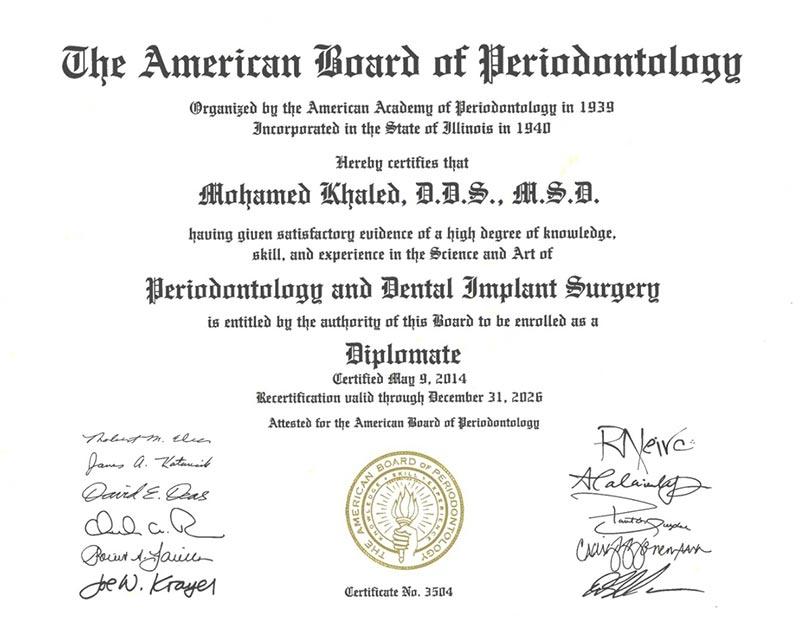
Dr. Mohamed Khaled is a Diplomate of the American Board of Periodontology with more than 18 years of specialty experience. At Sterling Periodontics & Implantology, patients receive a written treatment plan that explains the recommended approach, alternatives, timing, and case-specific costs before treatment begins.
Learn more about periodontal treatment in Beverly Hills.
10
Frequently Asked Questions
What is the best treatment for gum disease?
The appropriate treatment depends on the diagnosis, stage and grade of disease, affected sites, risk factors, and response to initial care. Treatment may begin with professional cleaning or scaling and root planing, while more complex cases may require surgical or regenerative therapy.
Can gum disease be reversed?
Plaque-induced gingivitis can generally resolve when inflammation is controlled and there has been no attachment or bone loss. Periodontitis involves permanent loss of supporting tissues, but treatment can control disease and selected defects may be candidates for regenerative procedures.
Is LANAP better than traditional gum surgery?
Neither approach is best for every case. LANAP is a laser-assisted protocol that may be appropriate for selected patients, while conventional surgery may provide needed access, reshaping, or regeneration for other defect patterns. A periodontal examination determines the reasonable options.
How long does gum disease treatment take?
Timing varies with disease extent, the treatment selected, healing, and response at re-evaluation. Active therapy may involve multiple visits, followed by long-term periodontal maintenance rather than a single fixed end date.
Does gum disease treatment hurt?
Local anesthesia is used as appropriate during scaling and root planing or surgery. Tenderness and sensitivity afterward vary by procedure and patient. Your periodontal team will explain comfort options and aftercare before treatment.
What happens if periodontitis is left untreated?
Periodontitis can progress and damage the tissues and bone supporting the teeth, potentially contributing to mobility and tooth loss. The rate of progression differs among patients, which is why diagnosis and ongoing monitoring matter.
When should I see a periodontist?
A specialist evaluation may be appropriate when bone or attachment loss is present, disease is advanced or complex, recession requires correction, implants are being considered, or previous treatment has not achieved periodontal stability. Your general dentist may also recommend referral.
Clinical references
American Academy of Periodontology: Staging and Grading Periodontitis
American Dental Association: Periodontitis
American Dental Association: Nonsurgical Treatment Guideline
This article is general education and does not replace diagnosis or individualized medical advice.